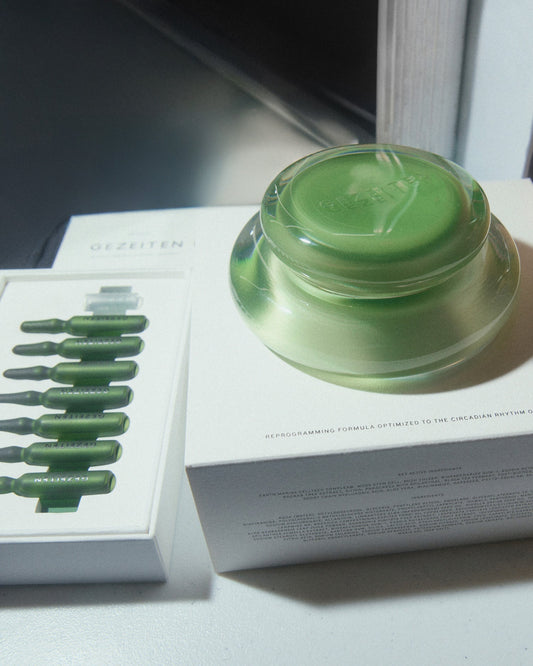
What does the body do during sleep?
During sleep, the brain consolidates memories, processes information and supports the clearance of metabolic waste. The body simultaneously regulates immune activity, metabolism, hormones and tissue repair.
Regular, sufficient sleep gives these processes the time and conditions they need to work effectively. Sleep duration, timing, regularity and quality all contribute to long-term physical and cognitive health. [6] Its benefits also become visible in the skin.
Repeated sleep restriction can interfere with barrier recovery and increase visible signs of fatigue and dehydration. Sleep and skincare perform different roles, but both influence how resilient, hydrated and rested the skin appears. [3]
How does the skin know whether it is day or night?
The body keeps time through a network of molecular clocks, with light acting as the primary external signal.
The central clock is located in the suprachiasmatic nucleus, or SCN, in the brain. Light-sensitive cells in the retina transmit information about the surrounding light-dark cycle to this master clock, synchronising it with the external day. [1]
The SCN then coordinates timing signals throughout the body. Organs and tissues, including the skin, also contain their own peripheral clocks, which help organise when specific biological processes increase or decrease. [1,2]
Light is the strongest external time signal. Meal timing, physical activity, temperature and behaviour can also influence peripheral clocks. [1]
This is why the skin at 10 p.m. functions in a different biological context from the skin at 10 a.m.
During the day, it faces UV radiation, pollution, climate and oxidative stress. Daytime skincare therefore prioritises protection. At night, environmental exposure decreases, cellular renewal increases and the barrier becomes more permeable. This creates a specific context for nighttime skincare: activating renewal, replenishing moisture and essential lipids, and strengthening barrier function. [2]
What changes in the skin at night?
Several aspects of skin physiology change according to circadian timing. The exact pattern can vary between individuals and is influenced by factors including age, sleep timing, environment and health. [2]
Cellular renewal increases
Skin cells continually renew themselves, but the rate of cellular activity changes across the day and night. Cell proliferation and repair-related activity are influenced by the skin's circadian rhythm. [2]
At night, reduced environmental exposure creates a different context for renewal. Renewal-focused ingredients can be integrated into the evening routine to address wrinkles, uneven texture, firmness and other visible signs of ageing.
The skin continues repairing and renewing itself throughout the day. Circadian timing influences when particular processes increase or decrease rather than restricting all repair to one universal nighttime window.
Water loss rises
Transepidermal water loss describes the movement of water from within the skin through its outer barrier and into the surrounding air.
This water loss commonly increases during the evening and night as barrier permeability changes. Skin may consequently feel drier, tighter or less comfortable in the morning, especially when the barrier is already depleted. [2]
Humectants attract and retain water, while ceramides and other essential lipids reinforce the barrier and help limit moisture loss. A well-formulated night cream combines these functions rather than relying on richness alone.
Temperature and blood flow change
Skin temperature and cutaneous blood flow follow daily rhythms connected to the body's regulation of heat and sleep. [2]
These physiological changes influence how the skin feels throughout the night. The performance of a topical formula still depends on its complete composition, active ingredients, delivery system and suitability for the skin.
Immune activity follows circadian timing
The skin barrier and immune system work closely together. Skin immune activity changes according to circadian timing, while an impaired barrier allows irritants and environmental triggers to penetrate more easily. [2]
Strengthening the barrier therefore contributes to more than hydration. It also improves the skin's resilience and protective function.
How does insufficient sleep affect the skin?
Repeated sleep restriction reduces the time and conditions available for coordinated biological recovery.
Experimental research indicates that insufficient sleep can slow the recovery of the skin barrier after disruption. Dehydration, dullness and visible signs of fatigue may also become more apparent when inadequate sleep becomes a pattern. [3]
One short night does not determine the long-term condition of the skin. Regular sleep timing, sufficient duration and good sleep quality create the most reliable foundation for recovery. [6]
Persistent sleep problems deserve medical attention. Skincare can improve the skin's condition, but it cannot replace healthy sleep or treat a sleep disorder.
Does nighttime skincare work better?
A product's efficacy depends on its complete formulation, active ingredients, stability, delivery and suitability for the skin. Applying a product at night alone does not make it more effective.
Timing becomes valuable when a formula is developed specifically for the skin's nighttime biology.
Nighttime is particularly suited to:
- Renewal-focused actives such as retinal
- Actives targeting visible processes associated with cellular ageing
- Barrier-strengthening ceramides and essential lipids
- Humectants that replenish overnight moisture loss
- Richer textures that provide lasting comfort
- Formulas developed to activate regeneration and renewal
A precise routine is more effective than excessive layering. Combining several intensive actives without considering tolerance can compromise the barrier instead of strengthening it.
Which active ingredients are particularly relevant at night?
Different active ingredients perform different functions. A targeted nighttime routine can combine cellular stimulation, renewal and barrier replenishment without asking every product to perform the same role.
• Senolytic rose active: targeting "zombie cells"
As cells age or become stressed, some stop dividing without being naturally removed. These senescent cells remain metabolically active and are often referred to as "zombie cells". Their accumulation can affect surrounding healthy cells and contribute to declining vitality, resilience and visible signs of ageing.
The senolytic rose active targets the visible effects associated with senescent cells, supports cellular renewal and helps restore skin vitality and resilience.
Found in: Serum · Stimulation & Rejuvenation
Encapsulated retinal: activating cellular renewal
Retinal, also known as retinaldehyde, is one of the most advanced and efficient cosmetic forms of vitamin A. It requires only one conversion step to become biologically active in the skin, where it accelerates epidermal renewal, promotes collagen production and improves wrinkles, uneven texture and visible loss of firmness. [4]
Encapsulation protects the active, improves its stability and enables precise, controlled delivery for high efficacy with improved tolerability. Individual frequency should still be adapted to the skin's tolerance.
Bakuchiol: complementing renewal
Bakuchiol is a plant-derived active that supports collagen production and cellular renewal while improving wrinkles, pigmentation, uneven texture and visible loss of firmness.
A randomised, double-blind clinical study found that topical bakuchiol and retinol both improved visible signs of photoageing over a twelve-week period, with bakuchiol demonstrating better tolerability. [5]
Ceramides and essential lipids: strengthening the barrier
Ceramides and essential lipids are structural components of the skin barrier. They help retain moisture, protect against external stressors and maintain the skin's strength and resilience.
As water loss increases at night, replenishing these lipids becomes particularly important. They reinforce the skin's protective structure, improve comfort and help preserve hydration throughout the night. [2]
Chrono-active bush clover extract: supporting overnight recovery
Bush Clover Extract helps resynchronise the skin's natural rhythm while reducing visible signs of fatigue, puffiness and oxidative stress, for a fresher, more rested-looking complexion by morning.
Marine biotechnology: optimising skin function
Marine organisms survive under changing and often extreme environmental conditions. Biotechnology makes it possible to identify and produce marine-derived actives with highly specific benefits for the skin.
Advanced marine biotechnology supports regeneration, strengthens resilience and helps optimise hydration, barrier function and overall skin vitality.
Telomere-supporting active: targeting cellular ageing
Telomeres protect the ends of chromosomes but naturally shorten as cells divide and age. A telomere-supporting active helps protect cellular longevity and maintain healthier skin function, contributing to improved firmness, elasticity and resilience.
Found in: Face Cream Night · Intensive Anti-Aging
How should you choose nighttime skincare?
The skin's circadian rhythm creates the context. Its current condition determines the formula.
• For dehydrated or depleted skin
Prioritise humectants, ceramides and essential lipids that replenish moisture, improve comfort and strengthen barrier function.
• For mature skin
Choose a renewal-focused formula developed to activate cellular processes, promote collagen production and improve wrinkles, firmness, elasticity and density.
• For skin showing reduced vitality
A concentrated serum with a senolytic active can provide a targeted first step before the night cream. The serum addresses cellular stimulation, while the cream completes renewal, regeneration and barrier replenishment.
• For sensitive or reactive skin
Build the routine gradually and select actives according to the skin's tolerance. A calm, intact barrier creates the foundation for more intensive treatment.
When using retinoids
Introduce the product according to its instructions and the skin's individual tolerance. Daily broad-spectrum sun protection remains essential.
Follow the individual product guidance and seek professional advice during pregnancy, breastfeeding or when managing a skin condition.